

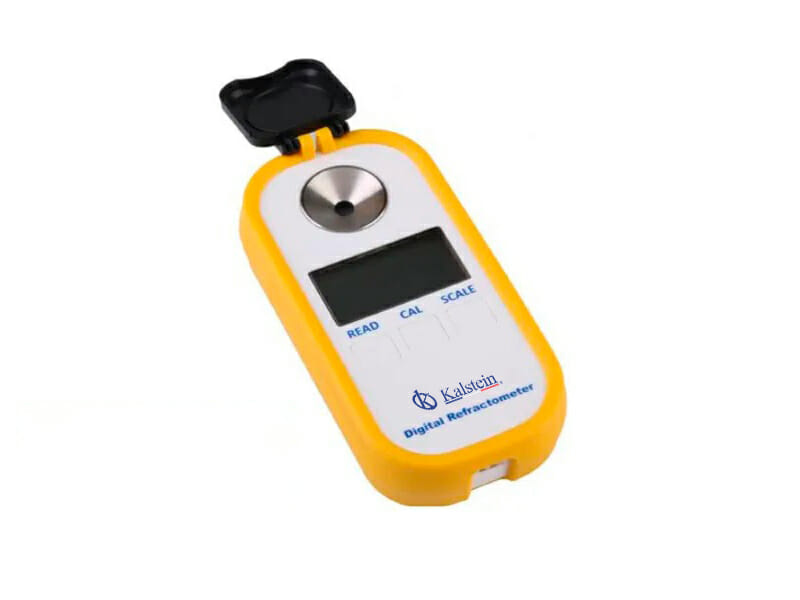
In today’s laboratory equipment market, precision instruments for measuring salinity are indispensable for various scientific and industrial applications. Two remarkable contenders in this domain are the Salinity Digital Refractometer YR05953/YR05960 by Kalstein and the Digital Salinity Refractometer Hi96822 by Hanna Instruments. Each shines in its own right, offering unique features for colleagues seeking quality and innovation.
The Salinity Digital Refractometer YR05953/YR05960 by Kalstein is a state-of-the-art device that offers unparalleled precision and ease of use. Designed for efficiency, it boasts a sleek design and robust construction. With the ability to measure salinity with high accuracy, it stands out for its reliability in various laboratory conditions. Its sturdy construction ensures durability, making it an excellent investment for laboratories needing consistent performance.
Digital Salinity Refractometer Hi96822 by Hanna Instruments, on the other hand, is engineered to offer quick and precise salinity readings. Known for its portable design and ease of operation, this refractometer is widely used in both laboratories and fieldwork. Hanna Instruments has integrated user-friendly features and precise measurement capabilities that appeal to those seeking immediate results in varied environments.
| Feature | Kalstein YR05953/YR05960 | Hanna Hi96822 |
|---|---|---|
| Brand | Kalstein | Hanna Instruments |
| Measurement Accuracy | High | Moderate |
| Durability | Exceptional | Standard |
| Ease of Use | Efficient | Easy |
| Portability | Compact | Portable |
| Price Range | Competitive | Moderate |
How They Work
The Kalstein YR05953/YR05960 operates by directing light through a prism where the salinity of a sample alters the refractive index, allowing precise measurement. This device is equipped with automatic temperature compensation, ensuring accuracy despite environmental temperature fluctuations.
The Hanna Hi96822 also uses light refraction technology to measure salinity. It is known for its digital LCD display that provides clear readings. However, its reliance on manual calibration can be a limitation when compared to Kalstein’s automatic capabilities.
What They Are Used For
These refractometers are essential in diverse industries, from marine biology to food technology, where accurate measurements of saline solutions are critical. Kalstein’s refractometer is particularly favored in high-precision laboratory environments due to its durability and accuracy. Conversely, Hanna’s refractometer is often used in field applications where portability and immediate readings are critical.
Types
Kalstein offers a range of digital refractometers tailored for varied salinity measurement tasks, ensuring that laboratories can select instruments perfectly suited for specific tasks. Hanna Instruments also provides a selection of refractometers, though their models are often intended for more generalized applications.
Market Price
The Kalstein YR05953/YR05960 is competitively priced, reflecting its quality and durability, often within a price range accessible to most laboratories. The Hanna Hi96822 typically falls in a similar range but tends to require more frequent recalibration, potentially adding to long-term costs. Pricing for both fluctuates, with periodic promotions available through authorized distributors.
Frequently Asked Questions
What is the primary use of a digital salinity refractometer?
Digital salinity refractometers are used to measure the salt content in liquid solutions, crucial for industries such as food production, aquaculture, and marine sciences.
How does automatic temperature compensation benefit measurement accuracy?
Automatic temperature compensation ensures that salinity measurements remain accurate even when the ambient temperature varies, which is particularly beneficial in field settings.
Is regular calibration necessary for these devices?
While regular calibration enhances accuracy, devices like the Kalstein YR05953/YR05960 are designed to minimize calibration frequency, unlike some models from other brands.
Advantages and Disadvantages
The Kalstein YR05953/YR05960 stands out for its superior measurement accuracy, robustness, and automatic temperature compensation, making it exemplary for precise applications. A slight disadvantage might be its less compact design compared to some portable models. In contrast, the Hanna Hi96822 offers great portability and ease for field use but may require more frequent calibration and lacks some advanced automated features found in Kalstein’s offering.
Usage in Field Applications
In practical scenarios, the Kalstein refractometer excels in laboratory conditions due to its precision and durability, often used extensively in controlled environments for research and quality control. Hanna’s model is well-suited for fieldwork, preferred for its ease of transport and user-friendly operation.
Recommendations
When using these refractometers, it is advised to regularly clean the prism to ensure consistent accuracy. For the Kalstein model, taking advantage of its advanced features can lead to more efficient laboratory workflows. Users are encouraged to explore the automatic quotation system on Kalstein Plus for a seamless procurement experience.
If you are looking for a fusion of innovation and quality, you have come to the right place. At Kalstein, we offer you the luxury of exploring our exclusive catalog of laboratory equipment. We manufacture each piece of equipment with a level of excellence. Our intuitive and agile online purchasing channels are designed for your convenience, ensuring the most friendly prices. Do not hesitate any longer; we bring science to life, it’s time to be part of our community. https://kalstein.eu/produit/salinity-digital-refractometer-yr05953-yr05960/?lang=en.