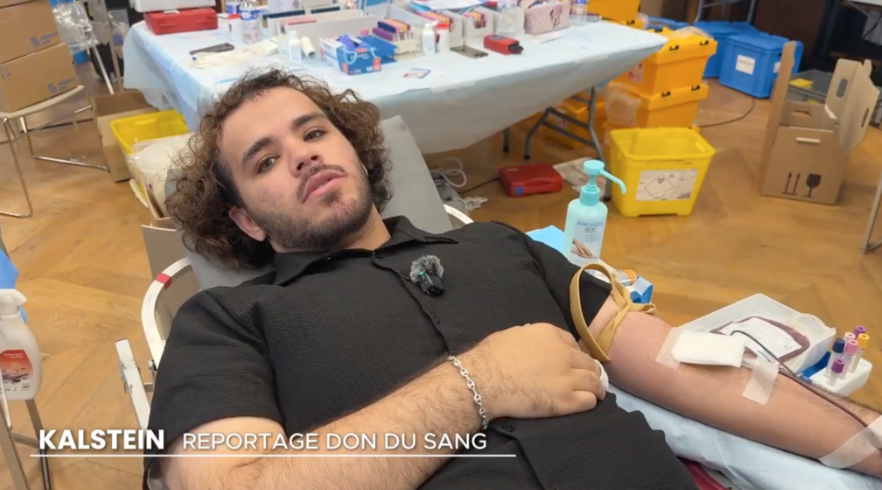
This Tuesday afternoon, the French Blood Establishment (EFS) organized a blood donation drive at the Town Hall of Paris’s 15th arrondissement. Kalstein employees answered the call.
Just a few steps from the office, the Town Hall of Paris’s 15th arrondissement hosted a blood donation campaign organized by the French Blood Establishment (EFS). Several Kalstein employees left their desks to take part in the initiative—a simple collective action whose impact is far from insignificant: a single blood donation can save up to three lives.
The atmosphere was both organized and welcoming. Presentation of identification documents, explanation of the process, and a consultation with a healthcare professional: each stage was conducted with careful attention to confidentiality and donor well-being. For first-time donors, an anemia test is systematically performed. If the hemoglobin level is below 12 g/dL, blood donation is not possible, although additional tests may be offered.
“If It Can Help Others and Benefit Me as Well, There’s No Reason Not to Donate”
For Abdel, it was his very first donation. Lying comfortably while being assisted by the medical team, he spoke calmly about the experience:
“So far, everything is fine. It should only take three or four minutes. The heat is the main thing—it’s hot today—but as for the donation itself, no, everything is fine for the moment.”
He added pragmatically:
“Unless someone has a fear of needles—and even then—you barely feel anything. There’s really no reason not to donate.”
After the donation, participants headed to the refreshment area, managed by Stéphane, an EFS volunteer. His responsibilities include setting up and dismantling the collection site, taking care of donors, serving snacks, and monitoring any signs of discomfort.
It is a role he takes very seriously, for deeply personal reasons:
“I was already aware of the importance of blood donation before joining EFS, but even more so now that I am being treated for leukemia. I returned just a week ago, so I understand even better the crucial role EFS plays.”
3% of Donors for 100% of the Need
The figures speak for themselves. Every year, one million patients receive treatment thanks to voluntary blood donations. Yet while 97% of French people say they support blood donation, only 3% actually donate.
The situation becomes even more challenging during the summer months. Blood reserves decline as regular donors leave on vacation, while medical needs remain constant. Approximately 10,000 donations are required every day to treat patients, accident victims, and people undergoing cancer treatment.
The eligibility requirements are straightforward: donors must be between 18 and 71 years old, be in good health, have slept well, eaten properly, stayed hydrated, and avoided physical exercise both before and after donating.
“The body uses a lot of energy during the process,” Stéphane explains.
“But if all these guidelines are followed, everything goes smoothly.”
Source: Kalstein Media