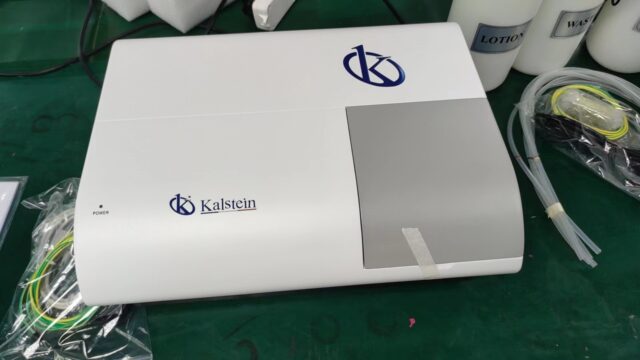
Microplate readers, (plate readers or microplate photometers) are used to detect biological, chemical or physical events of samples in microtiter plates. Microplate readers are widely used in the pharmaceutical and biotechnical industry, quality control and academic organizations. There are different types of detection modes detection modes for microplate assays, such as absorbance (ELISAs, enzyme activity, and nucleic acid and protein quantification), fluorescence intensity, luminescence, time-resolved fluorescence (TRF), and polarization.
Absorbance
Absorbance is used for assays such as ELISA assays, protein and nucleic acid quantification or enzyme activity assays. This process is based on transmitting light: a light source illuminates the sample (with specific wave light) and a light detector on the other side of the well measures the percentage of light transmitted through the sample. The amount of transmitted light is related to the concentration of the molecule of interest.
Fluorescence
The range of applications of fluorescence intensity is much broader than absorbance detection. In this type of instrumentation, a first optical system (excitation system) illuminates the sample using a specific wavelength. The sample emits light (it fluoresces) and a second optical system (emission system) collects the emitted light and measures the signal using a light detector.Luminescence
A typical luminescence optical system consists of a light-tight reading chamber and a PMT detector. The best reader for this method is a Photon Counting, which detects luminescent.Time-resolved fluorescence (TRF)
Time-resolved fluorescence (TRF) measurement is very similar to fluorescence intensity measurement, but with the timing of the excitation/measurement process. When measuring FI, the excitation and emission processes are simultaneous: the light emitted by the sample is measured while excitation is taking place.